
AnBer Foundation
Juliette Bataille
General Secretary
The AnBer Foundation has been supporting IECD projects for several years in very different countries and sectors (Ivory Coast, Syria, Madagascar, Palestine). Why did you choose IECD? What is its added value in your view? (What did you find in it? How does it meet your expectations?)
The AnBer Foundation has been supporting IECD for several years because your organisation is recognised, reliable, and deeply committed to working with the most vulnerable populations. What we particularly value is IECD’s ability to combine a long-term vision with operational efficiency, by developing concrete solutions tailored to local realities. Your approach, focused on training, professional integration, and economic development, aligns with our belief: giving everyone the means to become an actor in their own future.
We also share the same standards of quality, monitoring, and project evaluation, which are essential in our role as a foundation.
By supporting projects in varied contexts (post-conflict Syria, rural development in Madagascar, youth integration in Ivory Coast), what have you learned or changed in the way you act as a foundation?
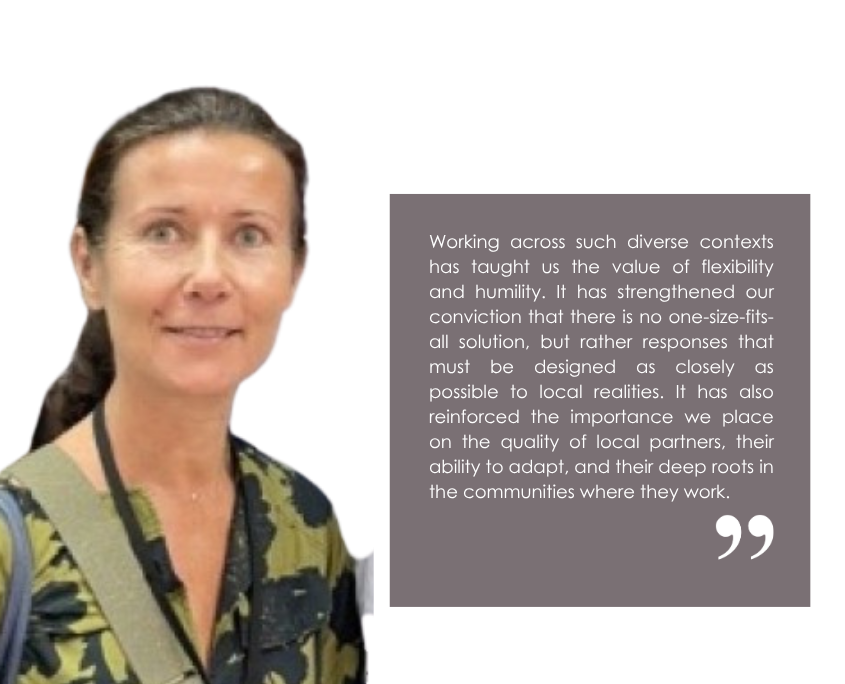
Supporting projects in such different contexts has taught us to be flexible and humble. We have strengthened our conviction that there is no single solution, but rather responses that must be built as closely as possible to local realities. This has also led us to place even greater importance on the quality of field actors, their adaptability, and their local anchoring.
With 120 projects supported per year worldwide, what makes an IECD project stand out to you?
Above all, it is about the encounter with project leaders, and of course the impact of the actions carried out. We aim to work closely with the organisations we support, to listen to their needs, and with IECD we find that the objectives are clear and relevant to local needs. In 2025, 32% of the AnBer Foundation’s support focused on professional integration, an area we share with you, with the aim of fostering beneficiaries’ autonomy by empowering them to act.
For the past two years, the Foundation has been supporting the project for small urban businesses. What does this collaboration bring you (in terms of your values, expertise, sector knowledge, country knowledge)? How do you envisage the continuation of this partnership in Ivory Coast?
This project illustrates an approach we value: supporting local economic development as a lever for inclusion. It allows us to combine social impact with economic momentum (and thus ensure the sustainability of actions). The AnBer Foundation does not commit to multi-year funding, but through its sheltered foundations, it is able to mobilise support around meaningful projects.
As both a family and umbrella foundation, the AnBer Foundation plays a dual role: initiating and amplifying philanthropic engagement. In a context where the needs of young people and vulnerable populations are increasing, how do you mobilise this dual lever to increase your impact?
Our specific strength indeed lies in this dual role. As a family foundation, we carry a strong vision and convictions that guide our commitments. As an umbrella foundation, we are able to host and support other philanthropic initiatives by structuring and securing them. In the context of growing needs, we aim to act as an amplifier of engagement by mobilising donors, supporting sheltered foundations, and directing funding towards high-impact projects.
Final words?
In a constantly evolving world, we believe more than ever in the importance of relying on strong field actors capable of acting concretely and sustainably. We are pleased to contribute, in our own way, to these dynamics that restore prospects for young people and the most vulnerable.