
TRAINING FOR BETTER HEALTHCARE
By 2030, the world could be facing a shortage of 11 million healthcare professionals. A staggering figure, but one that hides an unevenly distributed reality. Africa will be the hardest-hit region, with an estimated shortfall of 6.1 million healthcare professionals, or more than half (55%) of the projected global shortfall.
This major imbalance is the result of a combination of demographic, health and economic factors:
- An ageing world population: the number of people aged 60 and over in the world is expected to rise from 1.1 billion in 2023 to 1.4 billion by 2030. This trend is particularly marked and rapid in developing regions.
- an increase in the prevalence of chronic diseases: for example, the total number of people with diabetes is expected to rise from 171 million in 2000 to 366 million in 2030.
- persistent inequalities in access to healthcare: 4.5 billion people, or more than half the world’s population, still do not have full health cover.
- the migration of healthcare professionals to countries offering better working conditions, exacerbating geographical disparities.
(source: World Health Organisation)
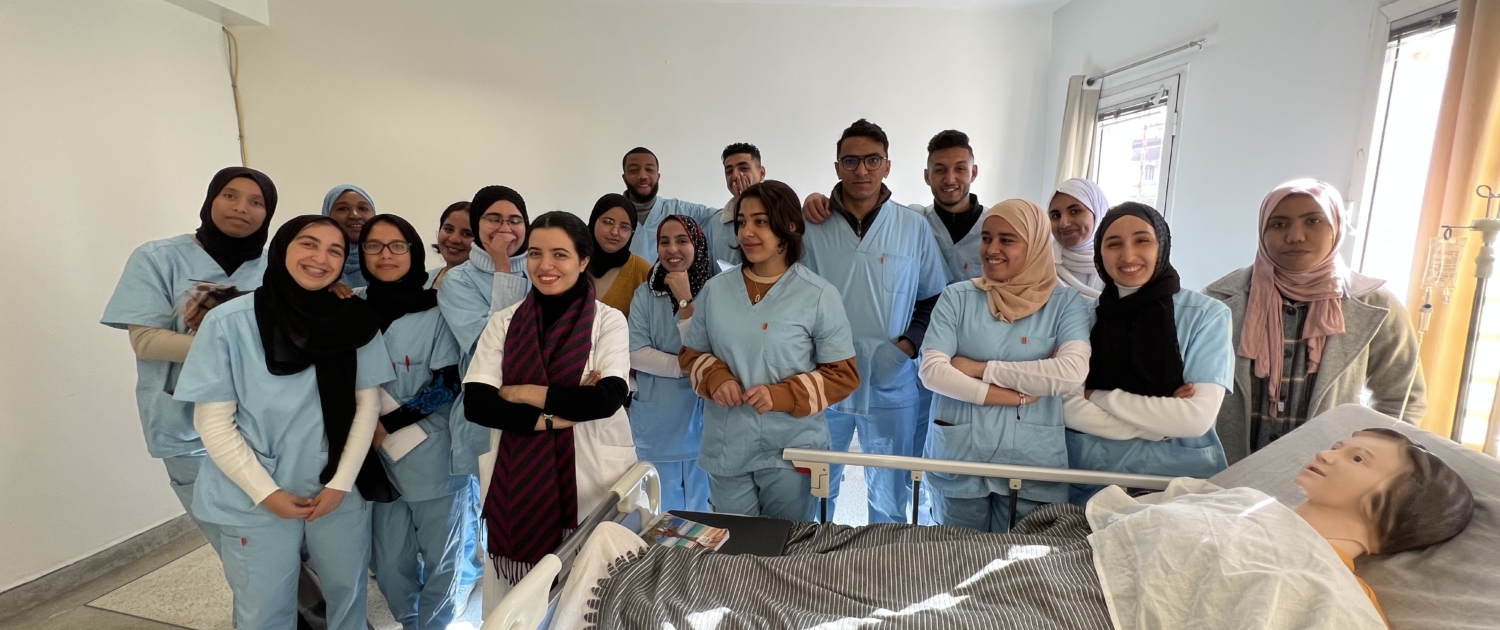
Faced with these challenges, training young people in healthcare professions, supporting the development of their skills and those of professionals, and promoting the structuring and recognition of these professions are key areas for development.
Concrete action on the ground
Through its ‘healthcare trades’ programme, IECD is implementing concrete actions in several countries:
- In Syria, Lebanon, Morocco, Egypt and Tunisia, a large number of young people are being trained as medical and social auxiliaries, opening up job prospects for them while helping to improve the day-to-day care of patients.
- In Lebanon, under the patronage of the Ministry of Health, professionals in 13 public hospitals are being strengthened through the direct training of health professionals (nurses, midwives) and the equipping of technical training centres. This will enable professionals who have already graduated to specialise, so that they can better meet the pressing needs of the population in terms of access to healthcare.
- In the Central African Republic, training for midwifery assistants has been set up to improve care for women and newborn babies. Over a two-year period, these professionals are trained to support women throughout their pregnancy, during childbirth and in the post-partum period. The aim of this scheme is to quickly make up for the glaring shortage of midwives in the countries concerned. The assistant midwives provide independent monitoring when everything is going normally, and refer patients to a midwife in the event of complications.
Investing in skills is investing in the future
Training, professionalising, improving the quality of care: the IECD works every day for a more inclusive and robust healthcare system. On World Health Day, the IECD reaffirms its commitment to equitable access to quality healthcare for all.
“The training was a very rewarding experience, both professionally and personally. The atmosphere was motivating and the team at Abdullah Al Rassi Hospital was very close-knit. Supported by my family, I gained in confidence and experience, which enabled me to be promoted to nurse.
I’m convinced that success doesn’t wait for those who wait, but rewards those who work hard and persevere to achieve their dreams. I want to encourage everyone to never give up, to remain determined, and to seize every opportunity to develop. For me, being a nurse is one of the noblest and most dignified professions there is.”
Nagham, a young beneficiary of the PARAMED programme in Lebanon.
“When I decided to enrol on this course, my family and friends didn’t understand my choice: for them, it was too difficult a profession. But I followed my heart. My parents are getting older, and I want to be able to help them – like so many other elderly people who need support.
At the start of the course, I was afraid I wouldn’t succeed. But the trainer was able to convey the knowledge clearly. I learnt a lot, including how to be patient and caring with older people. I can’t wait to start the practical training in a public nursing home. I’m convinced that we can really improve the lives of the elderly.”
Sally, a 22-year-old trainee in the personal care profession, in Syria.
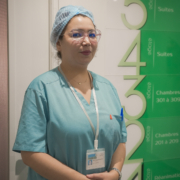
“The training is not only interesting, but also meets a growing need in our society, with the number of elderly people constantly increasing. It has given me the opportunity to develop a multitude of skills in the medico-social field, a sector that is essential for meeting the challenges of an ageing population.
The trainers have played a key role throughout. Thanks to their support, I was able to ensure the quality of my practical experience, which enabled me to develop my skills and gain a better understanding of the realities in the field.
At the end of the course, I was able to land a job as an assistant in a health centre. Today, I’m proud to help support the elderly and I’m grateful for the opportunity this training has given me.”
Asmaa, winner of the 2nd promotion of FAPAR training at the CDRT in Morocco.