
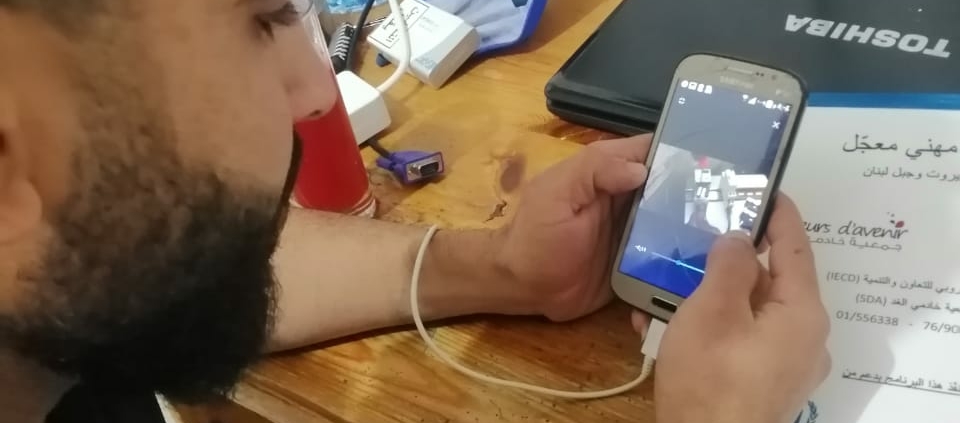
The IECD’s teams in Lebanon are being increasingly inventive to ensure the continuity of training
BEIRUT – 21 February 2020 – The first case of Coronavirus declared at Rafic Hariri Hospital in Beirut. At this same hospital, 18 people are following the IECD training in personal care of the elderly and sick (FAPAM) and are in the third week of a course that lasts 4 months. To protect the students from danger, the IECD actively sought an alternative, which it succeeded in finding on 11 March, the first day of lockdown announced by the Lebanese Prime Minister, Hassane Diab, which brought the training on site to an end. Despite the difficulties, the local teams had to be increasingly inventive in order to ensure that the young people could continue their training and that COVID-19 did not get the better of the FAPAM training and the people involved.
With almost 700 people benefiting from certified short training a year, Lebanon, along with Syria, is the IECD country of intervention that is implementing the greatest number of training in a time of crisis. Rolled out on a large scale in sectors with high demand (electricity, air-conditioning maintenance, plumbing, personal care for the elderly and sick, catering, etc.), their aim is to offer the keys to ensure rapid integration into the world of work that will allow the participants to earn a living wage.
Rana Jammal, the project manager for certified short training in Lebanon tells us how the IECD’s teams have adapted their activities to tackle the health crisis and ensure that beneficiaries, already greatly affected by the serious economic crisis, are not disadvantaged even further. Lockdown worsens a situation that is already extremely critical and sometimes the basic needs of the most disadvantaged are not met.
What has been the impact of lockdown on the activities that were in progress and what initial measures have you taken for beneficiaries?
“When the lockdown measures came into force, five courses were in progress, representing a total of 80 students. Our first action was to maintain regular contact with them via WhatsApp so as to help them overcome the crisis and design a distance learning program that included: the sending of Covid-19 prevention advice, practical advice on daily life in lockdown, and information concerning the actions of NGOs providing material assistance. Two days are devoted to technical training and one day to Life Skills with live sessions on WhatsApp with the trainers.
We ensure that everyone has access to WhatsApp and remains connected.
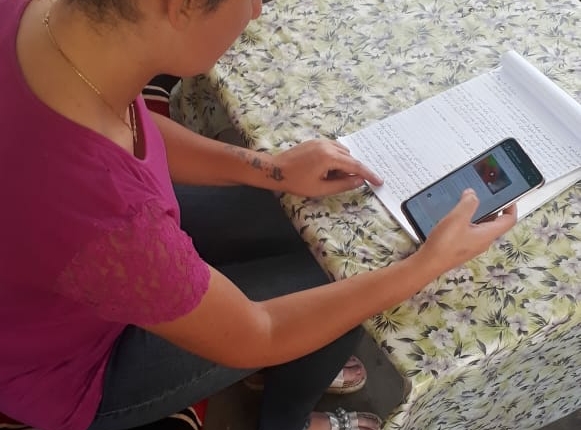
A student follows a training via the Whatsapp app.
How are the online classes going? How are you able to ensure the beneficiaries’ assiduity?
“The training content is updated to allow students to continue their training and not suffer too much from the lockdown. Collaborative work with the trainers and the IECD educational manager helped to identify content that could be taught online Concerning the Personal care of the elderly and sick training for example, the trainers film themselves: the gestures and techniques which they usually explain during a class are shown by video. The students greatly admire their trainers who are facing danger every day. They are even more motivated because they can see what this job really means and continuing training for them is a form of support!
With WhatsApp, communication is relatively easy and interactive: despite the financial, economic and psychological difficulties, the beneficiaries continue to participate in the sessions, especially the technical sessions. For us it is also a way of monitoring and eventually winning back the people we “lose”. So far only four students have dropped out. Indeed, some students are “absent” but when we contact them they confirm that they want to continue the training on site as soon as possible and explain their absence being caused by family obligations, work, or difficulty accessing the Internet. Out of the 80 students, about 60 participate actively in the interactive sessions organized via WhatsApp.
How do you see the post-Corona period and the return to business?
Our initial concern is to ensure that we do not waste the time of our beneficiaries who are all in need. Therefore, we are currently testing a validation system for theoretical aspects so as to be able to pick up the classes immediately with practical training.
Furthermore, online training is much in demand by our partners who have many requests on this subject. In particular, the HCR, which is in charge of refugees that represent a quarter of the Lebanese population. Therefore, we want to use the opportunity to speed up the development of our remote training. We are planning to adapt our content for posting online, for example, so that we can simulate maintenance operations in 3D. This work will be carried out by the team that is working as part of the social enterprise created by the IECD in 2016.
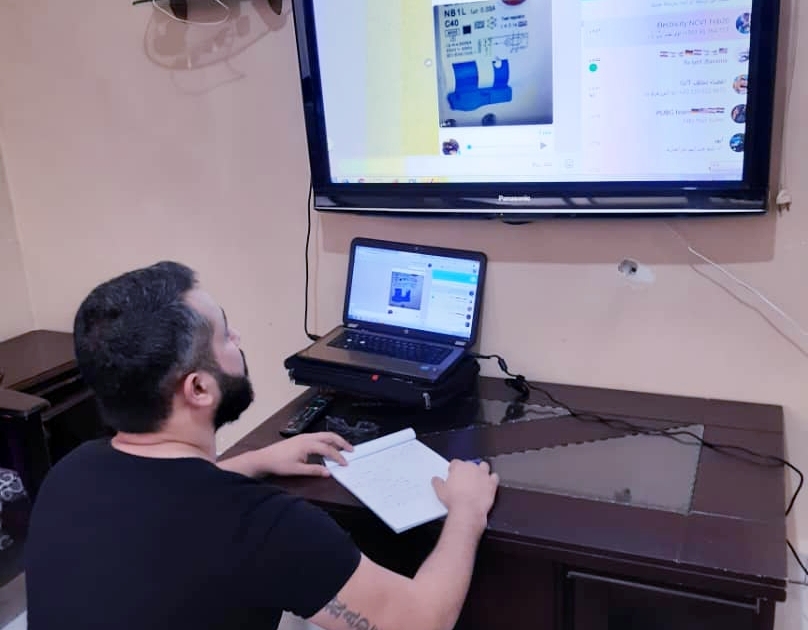
A student follows an online course thanks to videos the trainers had sent.
In a way, the Covid-19 crisis is offering you the chance to redesign your training content and the methods applied?
That’s true. It’s a worthwhile investment. Covid-19 allows us to make a great leap forwards in the development of digital tools. Without falling into the excess of “all digital”, it is possible to imagine a balance between remote training and real-life situations. This may meet the specific needs of people who are unable to leave their homes, or those who live very far from training sites. However, it should not be exclusive because hands-on experience is essential and digital cannot replace human contact or the importance of working in the field alongside others.
The development of online training is nevertheless a major asset that should allow us to reach even more people. Today, it is possible to imagine a complete range of training courses that are ever more relevant at the service of those most at risk and which could be rolled out to all the IECD’s programs and countries.