

About the IECD
83
development projects in Sub-Saharan Africa, in Madagascar, the Mediterranean basin, and Southeast Asia
16
countries
387
local partners
458
employees, including 413 in the operations countries
€ 26.8 M
operating budget
Key figures 2025
OUR HISTORY
The IECD was created in 1988 at the initiative of entrepreneurs and universities, including Xavier Boutin. Driven by the desire to show solidarity with people in need, they responded to calls from civil society in Madagascar (1989), in the Lebanon (1989) and in Cameroon (1992). From these three countries, The IECD has progressively established itself in Sub-Saharan Africa, the near East, Latin America (1994) and Southeast Asia (2004).
Education and vocational training are at the core of IECD teams’ actions, convinced that these are the keys to human development. Indeed, their mission is to promote development by strengthening peoples’ capacities and those of local partners.
Since 1989, the IECD has been implementing vocational training projects to promote the sustainable integration of the youth in the workforce. In 1992, it created the first Family Farm School in Cameroon, an initiative that gradually extended throughout the country and into the Ivory Coast and the Democratic Republic of the Congo (DRC). In 1994, the IECD participated in the creation of a hospitality curriculum by supporting the development of a vocational college in Beirut, the first step in the hospitality and tourism training programme. For the past ten years, the IECD has been multiplying its activities in the fields of professional integration, notably in industry and healthcare sectors.
In parallel, the IECD has engaged in supporting small businesses, the man driver of growth and job creation at a local level. In 1998, the first Management and Services Centre was inaugurated in Cameroon. The programme was replicated in the Ivory Coast, in the Democratic Republic of the Congo, in the Near East and in South-East Asia.
Finally, the IECD aims at providing education and healthcare access to vulnerable people. In 2006, it launched the first Educational and Remedial Centre (CERES) in the rural Fianarantsoa region of Madagascar. That same year it contributed to the programme PAFOVED in the Democratic Republic of the Congo to improve the care for those with sickle-cell disease.
Since 2010, IECD’s mission has officially been recognised as being in the public interest.
In 2026, IECD obtains an Equivalency Determination in the United States through NGOsource, facilitating funding from US foundations.
OUR GOVERNANCE
IECD is a not-for-profit organisation whose mission is recognised as being in the public interest.
Created in Strasbourg on January 8th 1988, the IECD is governed by Alsace-Moselle law and is written into the registry of associations of the District Court.
The IECD is directed by a Board of Trustees, which consists of 15 members who meet four times a year. The Board of Trustees defines the strategy and direction of the association and controls the general mandate for ongoing management as granted to the Executive Director. It legally binds the association and prepares the ordinary, and extraordinary, general meetings.
The Board is comprised of the President, Vice President, Treasurer and Secretary of the IECD. It meets every two months and is responsible for carrying out the decisions taken by the Board of Trustees.
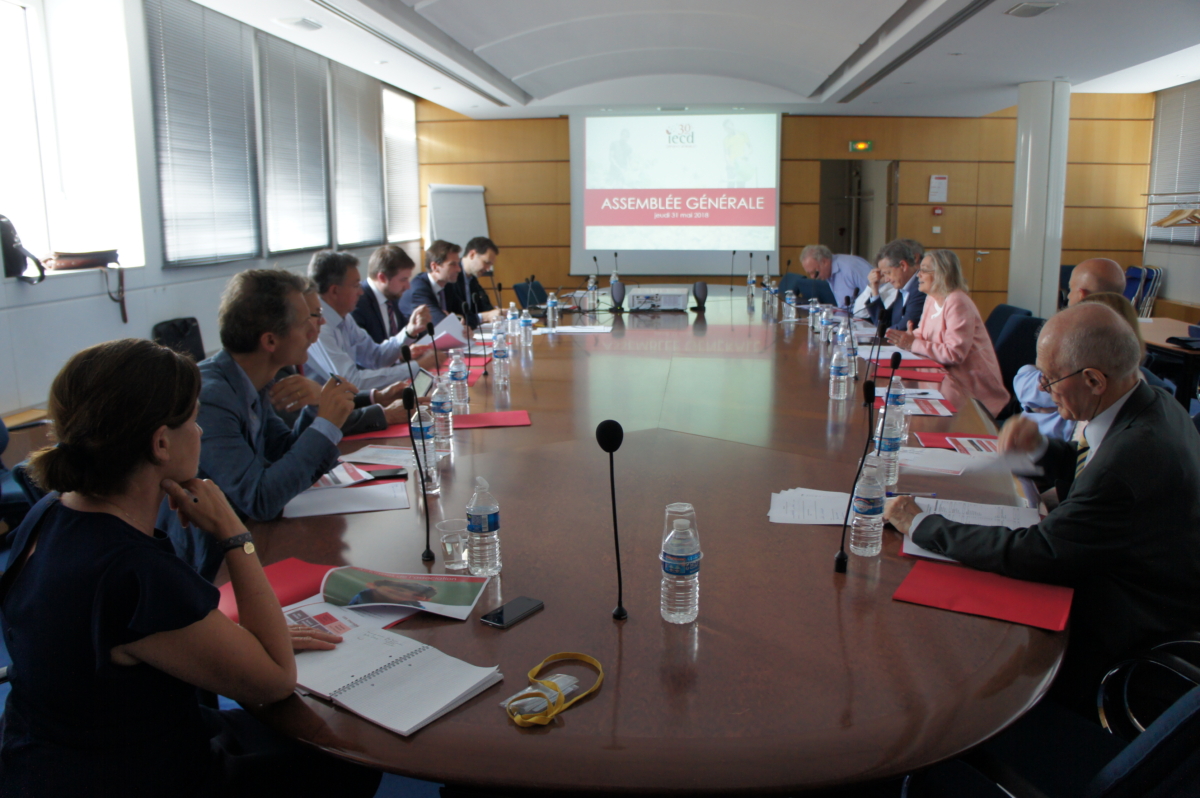
The General Meeting brings together all IECD’s active members once a year. It appoints administrators, approves the annual activity report that is delivered by the President, discharges the accounts after the presentation of the financial statements by the Treasurer, and validates the budget presented by the Board of Trustees.
THE BOARD
THE BOARD
President:
Marie-José NADAL
Vice – President:
Jean-Noël LUCAS
Secretary – General:
Hervé RUDAUX
Treasurer:
Michel BARONI
Xavier BOUTIN
Bernard DAVOUST
Amaury DUCHON
Caroline de CARTIER
Christian MALSCH
François MORINIÈRE
Emmanuel RIGAUX
Vanessa WARTHER
FINANCIAL RESOURCES
In 2025, the activity level of the IECD increased to €26.8 million, compared to €26.5 million in 2024.
In 2025, 41% of raised funds came from private donors, businesses and business foundations, endowments, associations, and philanthropic foundations. Public funds came from, among others, l’Agence française de développement, from the European Union, from UNICEF, etc.
Furthermore, individual donors support the IECD as a whole or support particular projects.
A financial plan is drawn up for each project over an average duration of three to five years. The necessary financial partnerships are developed accordingly, most often based on co-financing combining private and public funding.
Since its creation in 1988, the IECD has held itself to the highest standards and full transparency in managing its financing and expenditure. Monitoring, planning, and internal performance tools have been put in place to ensure efficient management of resources. In parallel, the IECD regularly undergoes technical and financial evaluations of its projects and internal and external audits.
Every year, an independent auditor certifies the accounts. the IECD then presents them at the Annual General Meeting of its members and reports to the regulatory oversight authorities. In 2024, they were certified by the firm HLP Audit, 3 chemin du Pressoir Chenaie – 44186 Nantes Cedex 4 – France.